
Alarm Management
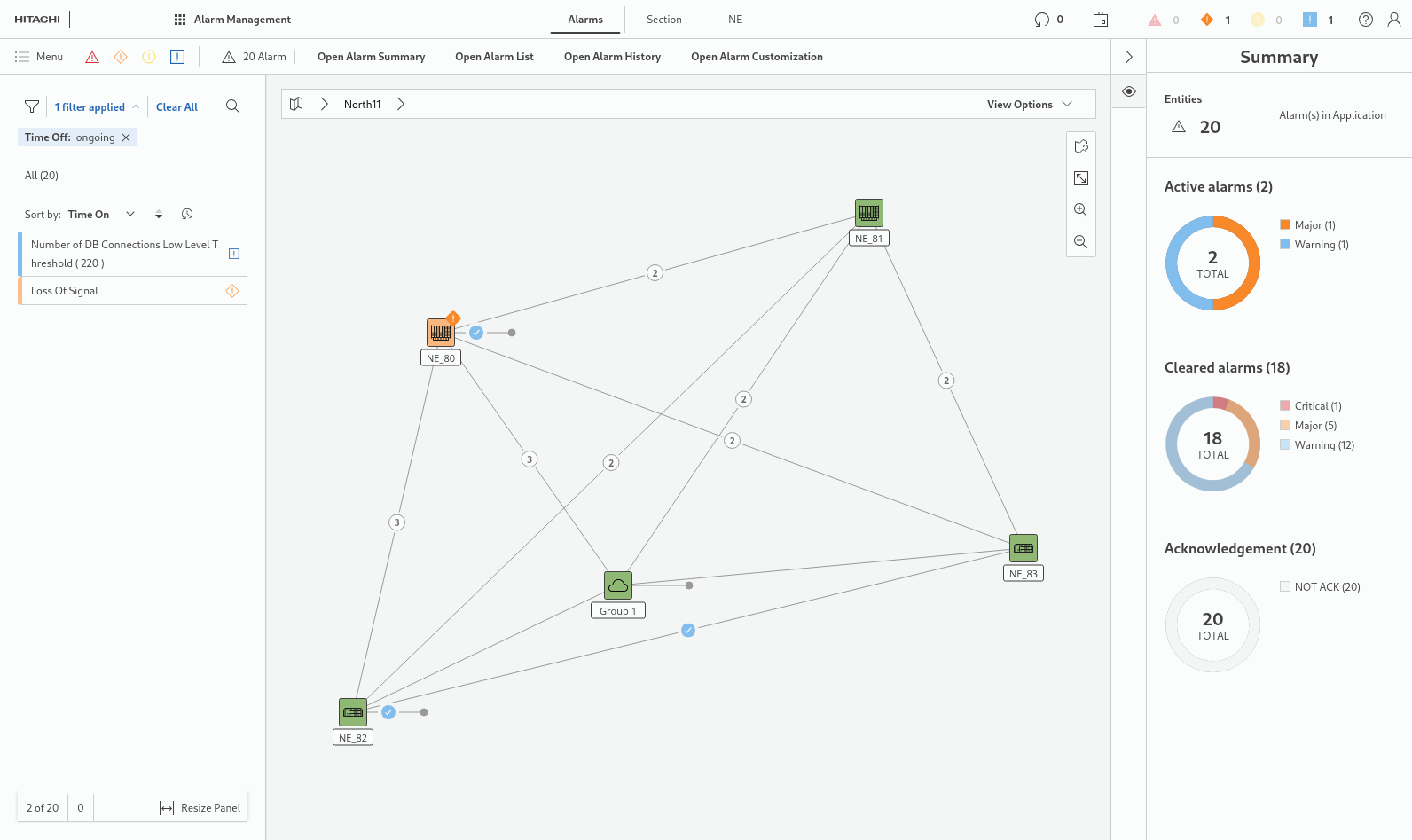
The alarm management includes an overview within the Web UI providing a map with the following views (tabs):
• Alarms,
• Section,
• NE.
Independent of the selected tab, the ribbon provides the following tools for monitoring alarms via a link for opening the (legacy) dialog:
• Alarm Summary (via “Open Alarm Summary”),
• Alarm List (via “Open Alarm List”),
• Alarm History (via “Open Alarm History”),
• Alarm Customisation (via “Open Alarm Customization”).
The following tabs are provided:
Alarms
The entity browser (left panel) lists alarms. The right panel shows a summary of all alarms in the network. When selecting an active alarm of an NE from the entity browser, the NE is highlighted on the map where the alarm is located. In the right panel, alarm details are provided for the selected alarm with
• Basic Information (including all relevant alarm details),
• Acknowledgment,
• Additional Information,
and the ribbon can be used to call the alarm’s details page, acknowledge the alarm, or pin the alarm in the right panel icon bar.
Section
This tab provides a list of physical and logical sections with filter options and a search utility. The right panel provides a summary of all entities (sections). When selecting one or several sections from the entity browser, the sections are highlighted on the map. In the right panel, details are provided for the selected section(s) with
• Summary,
• Configuration,
• Health Monitors
• Supervision,
• Issues,
• Related
for one selected section, and
• Summary,
• Supervision,
• Issues
for several selected sections.
NE
This tab provides a list of NEs with filter options and a search utility. The right panel provides a summary of all entities (NEs). For a selected NE, its icon is highlighted on the map. Detailed information is available as follows:
• Summary,
• Configuration (General, Basic Configuration, CEM & Teleprotection),
− MPLS-TP (essential information on supported features and resource usage),
− CE (Circuit Emulation) & TP (Teleprotection), where applicable,
− DCN (General, Interfaces, OSPF, Diagnostic),
− Synchronization (PETS, PTP),
• Diagnostic,
− TDM,
• Health Monitors (General, Details, NE Metrics),
• Issues (number of issues with severity critical, major, minor, warning),
• Related (Used By, Using - with all relevant details of parent and child relations).