
Diagnostic
Purpose
Provides OAM commands such as LSP ping, trace route, and delay measurements.
The commands are applicable to deployed valid LSPs.
Dialog image
Tunnel – Diagnostic
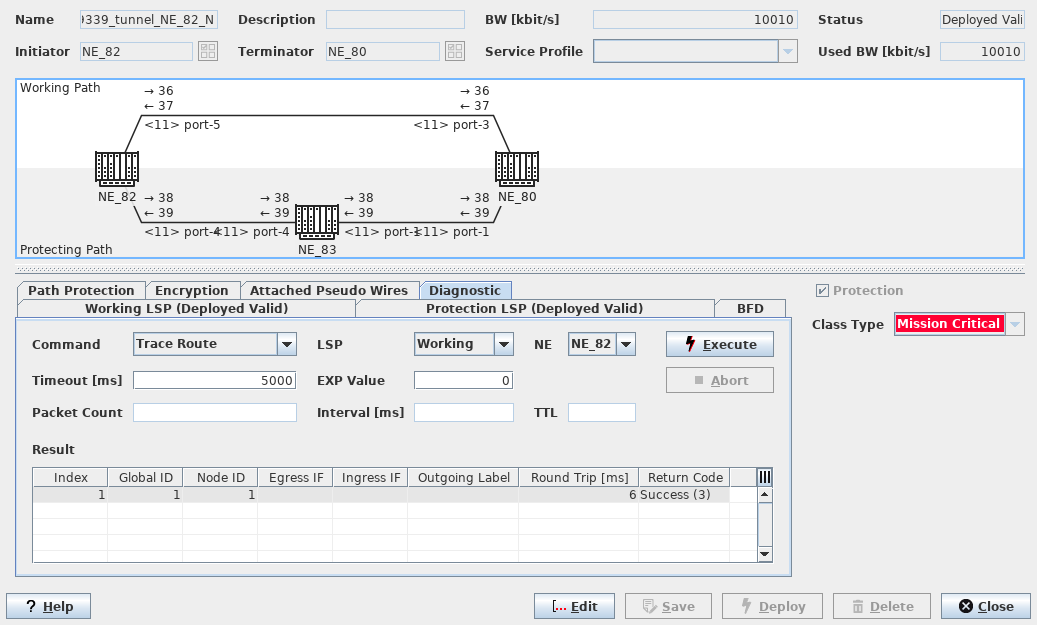
Mandatory entries
Not applicable.
Optional entries
Command parameters are optional (defaults can be used if appropriate).
Informational content
Name | The specified Name of the Service |
Initiator | The ingress Label Edge Router (LER) |
Terminator | The egress LER |
Description | The specified Description of the Service |
BW [kbit/s] | The allocated Service bandwidth. |
Used BW [kbit/s] | The allocated Service bandwidth. |
Status | The Pseudo Wire status: - Deploying/Removing: Display the Progress bar Indicating the current progress of deploying or deleting the selected Service(s). - Deployed Valid: The Service (both Pseudo Wire endpoints) is deployed to the MPLS-TP nodes. - Deployed Invalid: One side of the Pseudo Wire is missing or was not correctly deployed. It is saved in the FOXMAN‑UN database and is deployed to the nodes. - Saved OK: The Service, Pseudo Wire are saved in the database but not yet deployed in the MPLS-TP nodes. |
Controls (buttons, menu items, etc.)
OAM Commands
Command | Select one of the three OAM commands. - Ping: Ping the NE (the maintenance entity group end point MEP) at the end of the LSP. The resulting replies and round trip times are stored and displayed in the Result table. - Trace Route: Determine the route of a packet to the LSP end point. Each answering node returns information, which is stored and displayed in the Result table. - Delay Measurement: Measure the delay through the LSP. The measurement results are stored and displayed in the Result table. An overview and a detailed view is available. The measurement resolution is 1 ns (nanosecond). Some of the following parameters will show specific ranges depending on the command selected. |
LSP | Select one of the two LSPs - Working, - Protecting. |
NE | Select the NE from which the command shall be executed. This can either be the Initiator or the Terminator. |
Timeout [ms] | Set the timeout as follows: - for the Ping command: 200 to 10000 ms (default is 5000 ms); - for the Trace Route command: 200 to 10000 ms (default is 5000 ms). This is the timeout for response to a traceroute package; - the Delay Measurement command: 1 to 2000 s for (default is 5 s); if no message from the opposite side is received within this time the session will be canceled. The value entered shall be greater than “Interval”. |
EXP Value | Set the EXP value for the packets in the range 0 to 7. Default is 0. |
Packet Count | Set the number of packets as follows: - for the Ping command: Set the number of ping packets to be sent in the range 1 to 1024 (default is 5). - for the Delay Measurement command: Set the number of measurements to be executed on the LSP in the range 1 to 300 (default is 5). Not applicable to the Trace Route command. |
Interval | Set the interval as follows: - for the Ping command: Set the packet interval in the range 100 to 10000 ms (default is 1000 ms). - for the Delay Measurement command: Set the interval between delay measurements in seconds in the range 1 to 600 (default is 1 s). Not applicable to the Trace Route command. |
TTL | Set the Time To Live in the range 1 to 255. Not applicable to Trace Route and Delay Measurement commands. |
Verify Reverse | This option is not used currently. |
Execute | Execute the command. |
Abort | Abort the executed command. |
Result | Provides a result table listing the result of the executed command. In case of Ping the Result table includes one row with the latest results. In case of Trace Route the Result table includes all responding intermediate or end points. In case of Delay Measurement the Result table provides two tabs: - Overview, with a summary view of the measurement results: - Duration: the total duration of the measurement. - Result Count: the number of recorded results during the measurement. - Send [ns]: the min, max, and average of the packet delay in send direction seen from the selected NE. - Receive [ns]: the min, max, and average of the packet delay in receive direction seen from the selected NE. - Two Way [ns]: the min, max, and average sum of the packet delay in send and receive direction seen from the selected NE. - Round Trip [ns]: the min, max, and average of the packet round trip time, including the processing delay in the remote NE(s). - Remote [ns]: the min, max, and average of the packet processing delay in the remote NE(s). - Details, with the relative time and the above parameters listed for each packet sent for delay measurement. |
Table Sorting and Filtering/Export and Printing
Please refer to Table Sorter section for details.
Related dialogs / windows