
BFD (Bidirectional Forwarding Detection)
Purpose
Bidirectional Forwarding Detection (BFD) is a network protocol used to detect faults between two MEP endpoints connected by a link. The BFD establishes a session between these endpoints over a particular tunnel / link by exchanging control packets.
Both MEPs exchange BFD control packets at a regular interval. The local MEP sends Continuity Check (CC) packets at a defined “CC Interval” and the remote MEP monitors the arrival of the CC packets and detects loss of Continuity (LOC) if the packets fail to appear over a certain time period.
If the link or path is protected, separate BFD sessions (BFD CC Supervision) are automatically established in the working and protection LSP to monitor both links.
When BFD is activated 1 bandwidth of 10 kbit/s is allocated to the packets exchanged for this purpose.

Please note:
For background information, please refer to sections OAM and BFD and Protection Mechanism.
Dialog image
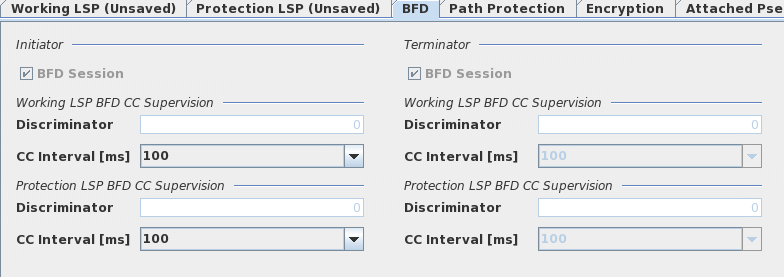
Mandatory entries
CC Interval
Optional entries
Not applicable.
Informational content
To achieve sub-50 ms path protection switch-over time, the default value of 3.3 ms CC interval is recommended.
Controls (buttons, menu items, etc.)
BFD Session | Enables/Disables the BFD session in the local and remote MEP (A End NE and Z End NE). If the Path is protected, a working LSP and protection LSP BFD sessions are automatically established. Note: When “BFD Session” is enabled, a bandwidth of 10 kbit/s is automatically added to the “In Use BW [kbit/s]” of the related tunnel. This specific bandwidth also adds per tunnel to the “Reserved BW [kbit/s]” of each Link. |
CC Interval [ms] | Defines the transmit interval the local MEP sends the CC packets. The value can be between 3.3 ms and 1000 ms |
Help
? Help | Calls the help viewer and opens this page. |
Table Sorting and Filtering/Export and Printing
Please refer to Table Sorter section for details.
Related dialogs / windows