
Traffic Protection Maps Introduction
Overview of traffic protection topologies
All networks need redundancy for enhanced reliability. Redundancy improves the availability of the network by implementing multiple paths for data to traverse the network. This allows the networks to be fault tolerant by providing an alternative path in case of a failure of a link, port or networking device.
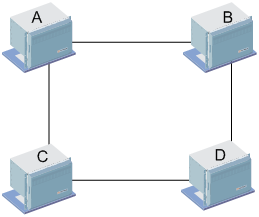
Physical Topology with redundant paths (looped)
However, redundant paths can introduce physical loops into the network. In a switched or bridged network, these loops cause broadcast storms, multiple frame transmissions, and Media Access Control (MAC) database instability. Network loops should therefore be avoided.
FOX61x R1C, R1D support the following protocols for loop avoidance solutions:
RSTP (Rapid Spanning Tree Protocol)
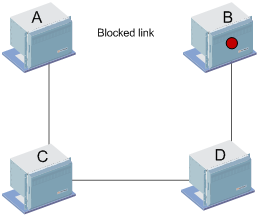
STP is a layer 2 link management protocol that is used to maintain a loop free network. A loop-free topology is accomplished when the switch or bridge recognizes a loop in the topology, and logically blocks one or more redundant ports automatically as shown in figure RSTP Loop-Free Topology: redundant path blocked.
 o
oRSTP Loop-Free Topology: redundant path blocked
RSTP is designed to significantly speed up the calculation of the spanning tree (convergence time) when network topology changes as compared to STP convergence time of 50 seconds.
With RSTP, the convergence time or the time required to reconfigure the network is roughly in the range of 300 ms (for the point-to-point link between 2 switches) to 5 seconds (for ring topologies with up to 19 switches).