Legacy Services
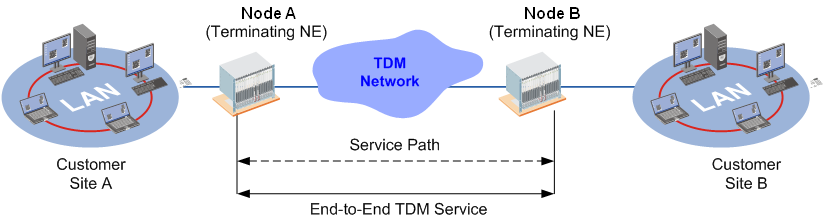
The sample EoS network diagram below illustrates the boundary of the FOXMAN‑UN’s end-to-end service monitoring and an overview of the Service Path.
• Service
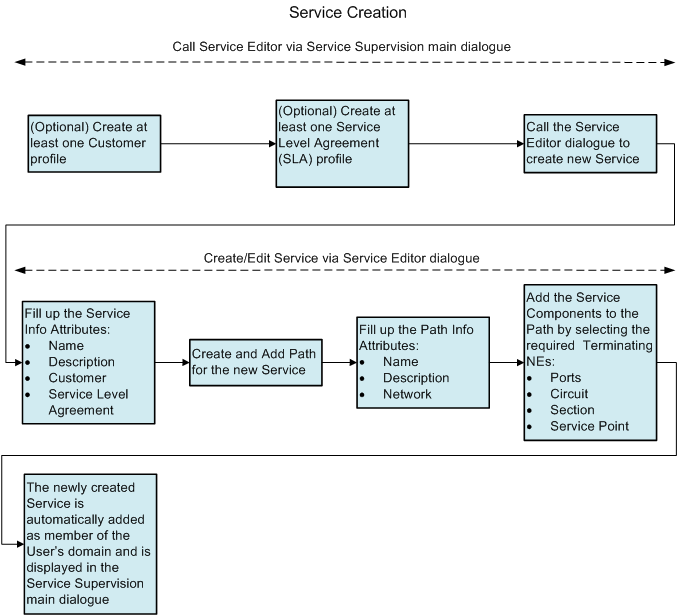
A service is a a collection of Service Paths, where a Service Path provides one complete “channel” of the intended service. A service must have at least one path.
• Path
A Service Path or transport route defines one complete channel of the service. It is a combination of Service Components.
• Service Components
A Service Component, which represents a physical or logical element in the network, can be:
− Port,
− Circuit,
The Networking Package (NP) must be enabled for Circuits to be part of a service. If NP is disabled, the operator can use only the Ports, Sections and Service Points for creating a Service Path.
− Section,
− Service Point (SP),
A FOXMAN‑UN object, where key service control and configuration resides. For example, an EOS service SP represents the point where EOS is enabled/disabled and where EOS specific alarms would be addressed.
Other supported Service Point types are as follows: X21, RS232 (V24/V28), E&M, and E1.
− Tunnel,
MPLS-TP tunnels used for VPLS or VPWS. To select tunnels as service components an MPLS-TP network is required with at least a tunnel configured.
The diagram below illustrates a single end-to-end service with two different Paths (or transport routes).
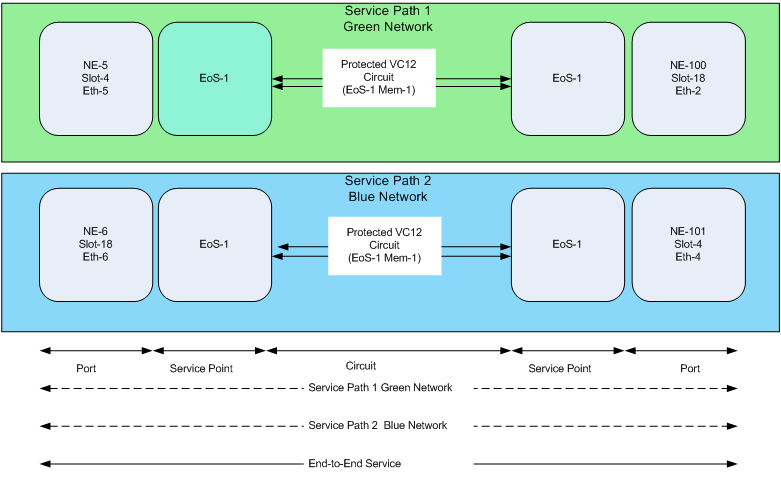
FOXMAN‑UN must maintain and present the operational state and fault state of all services defined by the operator.
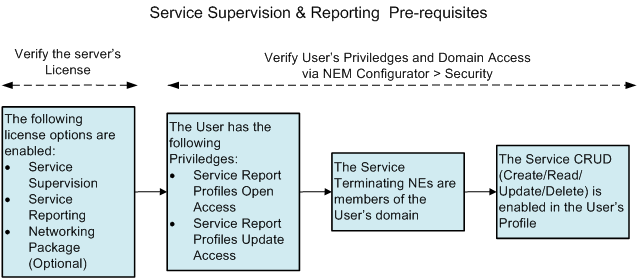
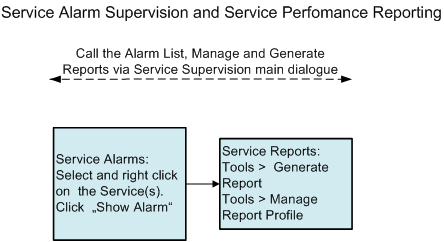
Service Creation and Reporting Process Overview
− The Service Components Port and Service Point are restricted by Role Based Access Control (RBAC), where the NE must be in the users Domain.
− The Service Components Section and Circuit are restricted by DAC, where either endpoint TTP must belong to an NE in the users Domain.
− The Service Point data for nodes will only be available with the addition of the following line in /opt/nem/etc/np.conf:
ifpoint_data_koap_support enable