
ENP Terminology
This section describes the basic MPLS-TP concepts to provide background information in understanding the ENP implementation. It includes the following topic:
MPLS-TP Overview
Multiprotocol Label Switching – Transport Profile (MPLS-TP) enables MPLS-TP to be deployed in a transport network and operated in a similar manner to existing transport technologies, namely SDH. The objective is to achieve the transport characteristics of SDH that are connection oriented with a high level of availability, quality of service, and OAM capabilities1.
MPLS-TP network provisioning can be achieved via a centralized Network Management System (NMS) for static provisioning and/or a distributed control plane for dynamic provisioning. FOXMAN‑UN current version supports static provisioning.
The main characteristics of MPLS-TP are:
− Connection oriented:
MPLS-TP uses Label Switched Paths (LSPs) and Pseudo Wires (PW) to deliver services.
− MPLS-TP can carry any type of client traffic such as ATM, SDH, Ethernet, etc.
− Transport layer agnostic:
MPLS-TP can run over Ethernet, SDH, OTN, Generic Framing Procedure (GFP) and Wavelength Division Multiplexing (WDM).
− Provides OAM capabilities similar to those provided by SDH and OTN.
Provides end-to-end protection and restoration mechanisms including:
− supports 1+1 protection and 1:n protection,
− LSP and PW protection.

Please note:
FOXMAN‑UN supports 1:1 bidirectional LSP protection.
• guaranteed 50 ms recovery time,
• MPLS-TP restoration mechanisms support revertive and non-revertive behavior.
MPLS-TP Architecture and Operations
This section provides an overview of MPLS-TP forwarding mechanism as well as the major components of an MPLS-TP network.
The figure below illustrates the MPLS-TP operation as connection-oriented transport system for packets. Traditionally packet transport switches each packet independently. However, with MPLS-TP, the connection is first setup between the endpoints and then all the traffic for that connection follows only this path through the network.
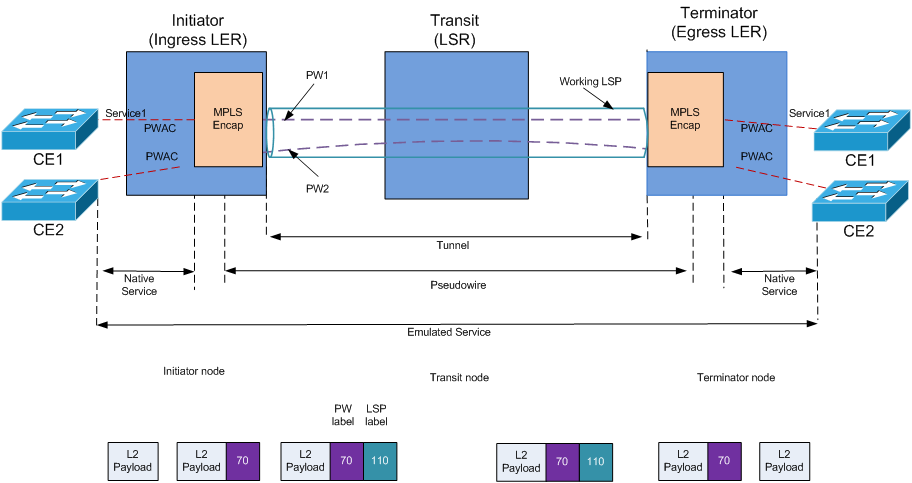
In all instances the forwarding of a packet is based on the LSP label (outer label).
In order for a packet to travel through a tunnel, the node at the transmitting side of the tunnel pushes a label relating to the tunnel on to the stack and send the packet to the next hop in the tunnel.
The intermediate nodes then use the label to make packet forwarding decisions.
Customer Edge (CE)
An MPLS-TP CE is in charge of interfacing with MPLS-TP networks.
Initiator node (Ingress LER)
This is the ingress Label Edge Router (LER). It can be found at the edge of an MPLS-TP network.
The PWAC port receives Ethernet user traffic (untagged, priority or VLAN tagged). The ingress LER then encapsulates the Ethernet frames into MPLS-TP frames by adding PW Header, LSP Header and the Ethernet destination and source addresses.
The figure below shows the entire encapsulation an untagged user traffic is given before it is transported via MPLS-TP.
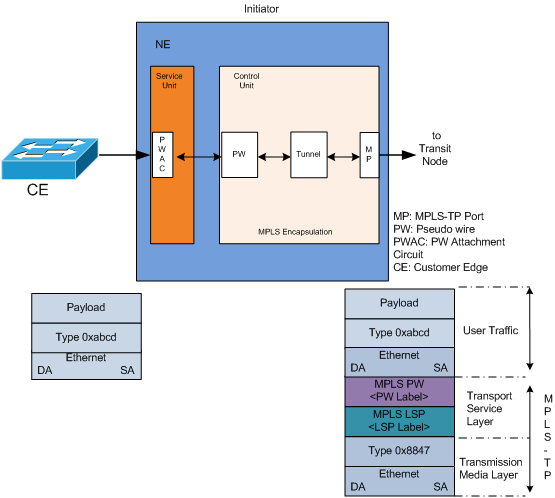
The Initiator’s components perform the following:
• Pseudo Wire Attachment Circuit (PWAC)
The PWAC maybe an Ethernet port or Ethernet VLAN attaching a CE to the edge router.
• MPLS-TP Encapsulation: PW Forwarder
Binds a PWAC to a particular Pseudo Wire (PW). The PW encapsulates service-specific PDU or circuit data received from PWAC.
Each PW is identified by a unique PW Label (inner label).
• MPLS-TP Encapsulation: Tunnel (LSP)
The encapsulated data are then carried over Label Switched Path (LSP) tunnel, a path through an MPLS-TP network. LSP can transport multiple PWs. Each LSP is identified by a unique LSP label (transport or outer label). This outer label serves to forward data through the network.
The Initiator performs label push. The remote or destination PW label and the next hop LSP label are added to the packet before sending the labeled packet through an outgoing NNI interface / SNI interface (MPLS-TP port) to the next node (see the illustration above).
An MPLS-TP port can be set up via the FOXCST GUI on a core unit front port either by…
− setting the Port Type Usage to “MPLS-TP”,
or by…
− setting the Port Type Usage to “VLAN Subinterfaces”,
− creating a VLAN Subinterface with a specific VLAN ID,
− setting this VLAN Subinterface’s Usage to “MPLS-TP”.
The corresponding settings need to be done on the remote end of the link (Transit, LSR and/or Terminator, Egress LER) as well.
Transit node
This is the Label Switch Router. Transit node maintains a mapping of an incoming label and incoming interface to one or more outgoing labels and outgoing interfaces in its forwarding database. When a labeled packet is received, the LSR examines the LSP label and performs LSP label switching before sending the labeled packet to the next hop.
Along the route, LSP labels are replaced or swapped with new LSP labels that are meaningful to next MPLS-TP node or next hop.
Terminator node
This is the egress LER. Terminator node pops the LSP label and sends the data to the appropriate PWAC based on its PW label. From the sample setup, the egress LER determines the attached PW label as its Local PW1 label. It will then send the packet to PWAC1 and finally to CE1.
Emulated Service
The emulated service refers to the transmission service that is provided to customers to allow them to transmit e.g. Ethernet frames. It connects the switch interfaces of the CE devices, thereby covering the entire transmission path.
Please note:
MPLS-TP enabled NEs, which are referred to as MPLS-TP nodes in this document, can act as Initiator, Transit or Terminator node.
• The control unit ports can be configured as MPLS-TP, PWAC or as CVP ports.
• The service units ports can be configured as PWAC or CVP ports.
LSP Label and PW Label
The MPLS-TP uses the MPLS-TP frame format and MPLS-TP label (shim header) for packet forwarding.
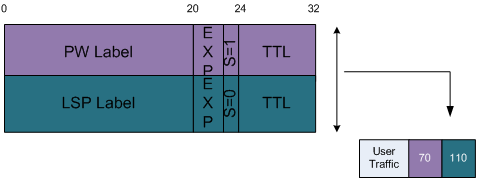
The MPLS-TP shim header is composed of:
− Label
This 20-bit field contains the value of the label. The MPLS-TP node uses the LSP label (outer) to forward the MPLS-TP packet over a specific LSP path.
Please note:
The 3-bit Experimental Use (EXP) field is mapped to Traffic Class (TC) to indicate the class of service (eight packet priorities) designated to the packet. Please refer to QoS (EXP) for further details.
• S
The 1-bit Stack (S) is used to identify the bottom of the stack.
S=0 means another label follows.
S=1 means this is the last label.
• TTL
The 8-bit Time to Live (TTL) is meant to avoid loops caused by configuration error. Every MPLS-TP node decrements the TTL field in the outer shim header by one whenever it receives a packet with a shim header. If the TTL reaches zero, the frame is discarded.
One or more labels are pushed on the packet at the ingress node. The first label is called the LSP label. This is also referred to as Transport or outer label.
The inner label is called the PW label, which identifies the specific client traffic or service. The PW label is sometimes referred to as Interworking label.
The ingress and egress LERs need to manage the PW labels. The intermediate LSR nodes in the network only manage LSP labels, e.g. for LSP label swapping.
Tunnel and Label Switched Path (LSP)
Label Switched Path (LSP) a path or route for switching MPLS-TP packets between the ingress and egress MPLS-TP nodes. An LSP is contained within a tunnel.
A tunnel starts at the Ingress LER, where LSP label is pushed and ends at the egress LER, where the LSP label is popped out of the stack. It may be composed of multiple LSPs. It manages the working and optionally a protecting LSP.
The Point-to-point LSPs are categorized into three types:
− Point-to-point unidirectional,
− Point-to-point associated bidirectional,
− Point-to-point co-routed associated bidirectional.
FOXMAN‑UN supports co-routed bidirectional LSP. The forward and reverse directions of a bidirectional LSP follow the same path, that is the same nodes and links from MPLS-TP node A to Z or from MPLS-TP node Z to A.
Pseudo Wire (PW)
Pseudo Wire (PW) is an emulation of the service attributes over a packet switched network. The client service is mapped to the Tunnels by using PW label to identify the service.
In MPLS-TP protocol, PWs are carried by Tunnels. Multiple PWs can be carried over a single tunnel.
1 Networks and Services: Carrier Ethernet, PBT, MPLS-TP and VPLS, M. Toy