
Rapid Spanning Tree Protocol (RSTP)
The RSTP is a layer 2 link management protocol used to provide network with alternative redundant paths with loop avoidance solution.
If a change occurs to the network topology e.g. due to a bridge or link failure, recalculation of the spanning tree is done to maintain a loop free topology.
The recalculation involves transitioning the Discarding ports to Forwarding ports or vice versa. During this transition the ports are not sending traffic data.
The network converges when all the switch and bridge ports have transitioned to either the Forwarding or Discarding state.
Rapid Spanning Tree Operation
RSTP initially converges on a logically loop-free network topology by doing the following steps:
1 Electing a root bridge
The protocol has a process to elect a root bridge. Only one bridge can act as root bridge in a given network. On root bridge, all ports are designated ports, which are forwarding (D) traffic data.
− Root bridge has the lowest BID (Bridged ID). The BID includes the priority and the MAC address of the bridge.
− An administrator can influence the decision by setting the switch priority to a smaller value than the default to make the BID smaller.
2 Selecting the root port on the non-root bridges
RSTP establishes one root port, which is forwarding data traffic, for each non-root bridge. The root port is the lowest-cost path from the non-root bridge to the root bridge.
Link Speed | Cost |
|---|---|
10 Gbps | 2 |
1 Gbps | 4 |
100 Mbps | 19 |
10 Mbps | 100 |
3 Selecting one designated port per segment
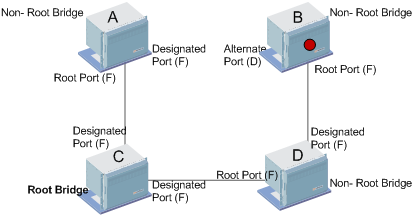
RSTP Operation
Port Roles and Port States
The Port role is variable, assigned to a given port.
• The Root Port and Designated Port are used for forwarding (F) data traffic.
• Alternate Port is in Discarding state
A backup of the Root port. If the Root port fails it can immediately transition into the Forwarding state and become the new Root port.
• Other port roles
− Backup Port
A backup of the Designated port and is in a Discarding state. If the Designated port in a shared segment fails, it will take over the role of the new Designated port.
Backup port is not often used as this would require connecting the bridge with multiple links to shared medium, e.g. a hub.
− Edge Port
A port that is the candidate for a quick transition to forwarding state as it connects device that cannot create the loop (no BPDUs received on that port).
Port States | Is Port Included in Active Topology? | Is Port Learning MAC Addresses? |
|---|---|---|
Discarding - No data traffic is sent over the port. | No | No |
Learning - Not forwarding data yet, but is populating its MAC-address table. | Yes | Yes |
Forwarding - Port is forwarding data traffic. | Yes | Yes |

Please note:
Current FOXMAN‑UN release will display:
• “Forwarding” port state only,
• “N/A” or not applicable port role for RSTP network.