Introduction to Networking Package (NP)
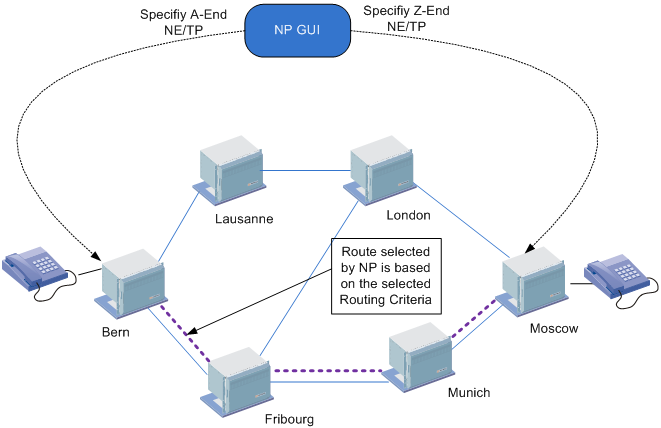
FOXMAN‑UN NP is an integrated function of FOXMAN‑UN that automates network and service provisioning for FOX51x and FOX61x networks.
It provides a system for fast and efficient:
• TDM end-to-end provisioning
− Existing end-to-end connections can be modified or deleted.
− New end-to-end connections can be created using the available network capacity.
• Network documentation
− Makes the discovery of all end-to-end connections.
− Keeps the information in its own database.
− Keeps its database synchronized with network changes.

Please note:
The end-to-end connection shall be referred to as Transport Entity (TE) throughout the document.
Application, Transport Entity (TE) and Path
The NP model is built of Application, Transport Entity (TE) and Path elements:
− The Application is a container of TEs. It contains at least one TE. (An empty Application is automatically deleted).
− The TE can be a circuit, a trail, a sub network circuit (SNC) or unknown.
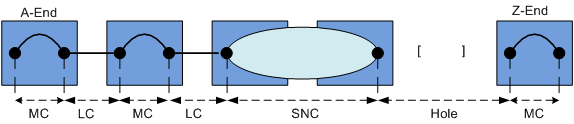
− TE has a Path, which connects the a-end TP (Terminating Point) with the z-end TP with path elements. The path elements can be a SNC, a LC, a MC or a Hole.
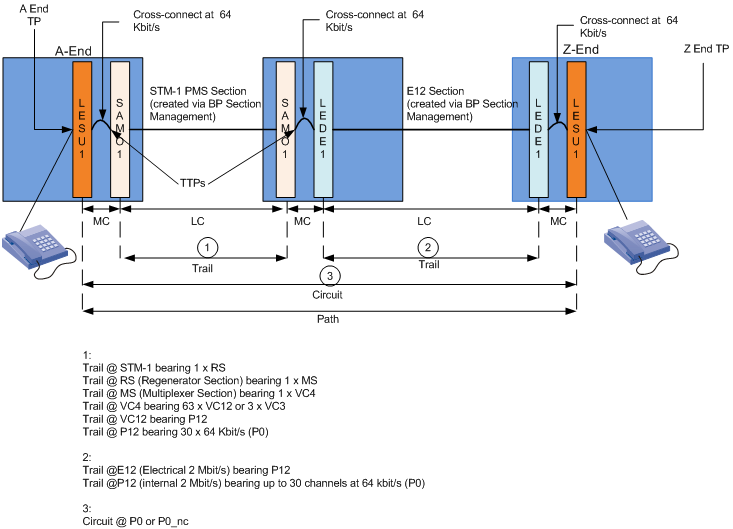
The diagram below illustrates the relationship of TEs and Path elements.
Transport Entity (TE)
The TE can be:
• Circuit
− User oriented connections between points at the border of the network.
− Has end-points that are connected to external equipment.
− Is always carried by one or more Trails.
• Trail
− A bandwidth resource that carries a multiplexed signal from one point to another in the network. The signal is demultiplexed at the extremities (Trail Termination Point, TTP) into points that can be cross-connected with other points in the same NE.
− Typical Trails seen in NP:
VC4 Trail, which demultiplexes into VC3,
P12 Trail, which demultiplexes into P0_nc.
• Subnetwork Connection (SNC)
− A partial circuit or Trail.
− Represents the transmission portion of a circuit (or trail) with one or both end points unterminated.
− Additional configuration must be added in order to complete the path necessary for traffic to pass.
• Unknown
− Any TE that is not a Circuit, Trail or SNC
Path
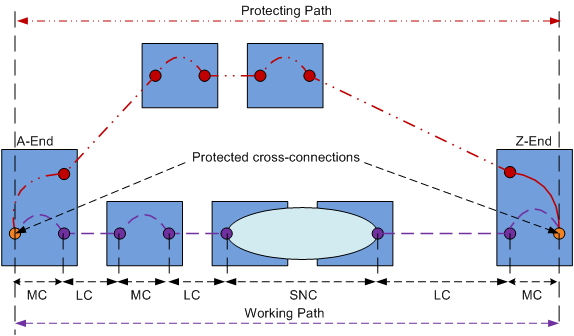
A TE has a Path. A protected TE has two Paths. Topological TEs have no paths.
A Path is a collection of:
• Matrix Connection (MC)
− Cross-connections in the FOX51x and FOX61x.
• Link Connection (LC)
− Sections created in the FOXMAN‑UN BP,
− Trail will generate one or more LCs.
• Subnetwork Connection (SNC)
− Parts of the network at a single layer (e.g. at P0_nc layer).
• Hole
− The routing has not been completed by the user. The FOXMAN‑UN NP allows only one hole.
NP Routing
TEs, e.g. circuits are created with an empty route.
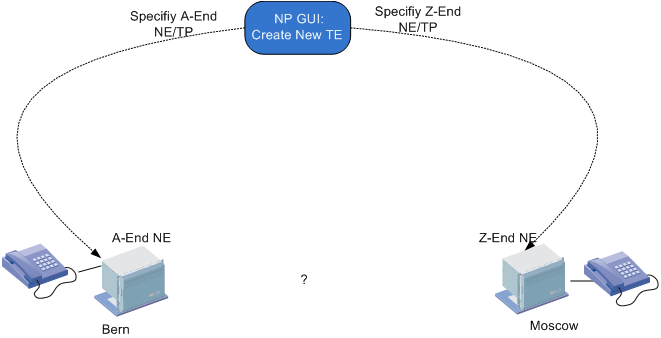
There are two methods of selecting the preferred route or Path in provisioning a circuit:
− Manual Routing,
− Automatic Routing.
Manual Routing
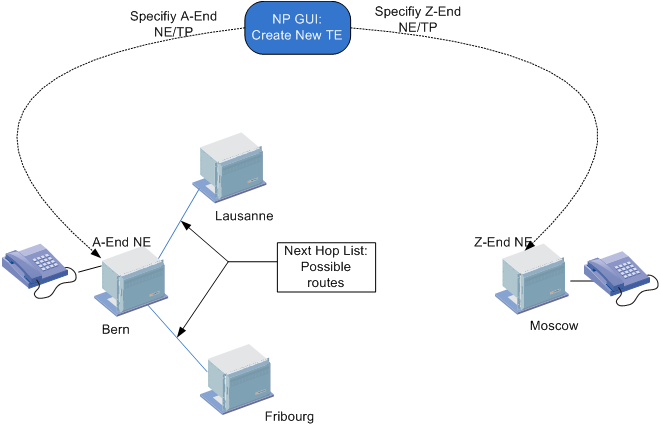
− at each node where one or more routes are possible, each valid “next hop” are offered and is selected by the user.
− The “next hop” list are end-to-end connections that are either Trails or SNCs that can be used to transport data from A-End to the next NE, thereby reducing the distance of incomplete Path. This process is repeated until the Path A-End and Z-Endpoint is complete.
Automatic Routing
NP makes a selection based upon the user’s configured automatic routing parameters.