
SNMP Northbound Interface (NBI) Trap only mode
In the default installation, the NBI loads all NE, CARD and ALARM tables in memory from the database (eventually duplicating or making local copies in the memory). The main purpose of loading these tables is to provide the walking access and sending traps to HLMs. A sample snmpwalk result for neTable is shown in Figures 1 and 2.
However, with FOXMAN-UN supporting 25K nodes, the size of the database grows and loading time of these tables would become very large and may lead to freezing or crashing of the system. Likewise, 90% of HLMs do not intend to walk these tables and are only interested in receiving traps corresponding to addition, deletion, change of state of NE & CARD units and for current or newly raised alarms.
Hence, starting R9B, it is possible to set the “trap only” mode for NBI. This mode does not load the tables in the memory or allow HLM walking access on the tables but will only send traps to HLMs.
Modify the «$NEM_HOME/etc/snmpagentd.conf» file as follows:
• Set snmp_no_cards_tables to «enable»
This parameter enables/disables the trap only mode. Default is set to «disable»
If this is set to “disable”,
− the SNMP NBI loads all NE, Card and Alarm tables in memory from database
− allows walkthrough of the tables
If this is set to “enable”,
− the NBI is set to “trap only” mode
− does not allow walkthrough of the tables
− will only send traps to HLM
− no table will be loaded into the memory from the database during the startup of the NBI daemon
• Add the parameter and value snmp_alarm_ne_card_batch_size 50
It sets the chunk size of the traps sent by the NBI. Default is set to 5.
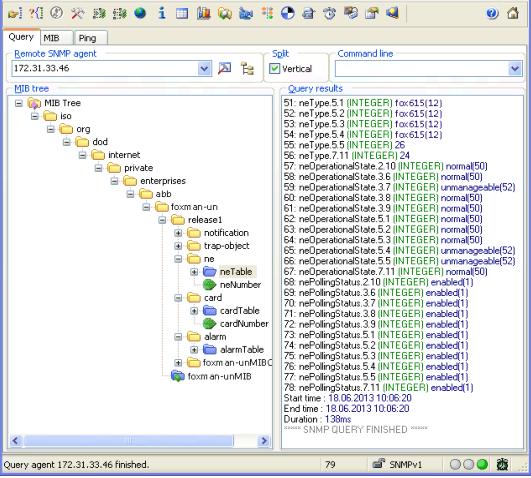
FOXMAN-UN MIB Tree and neTable walk
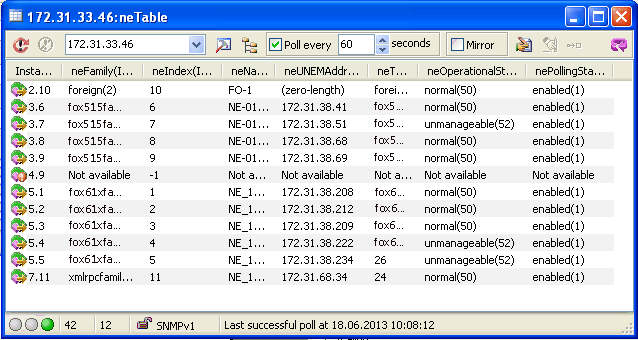
neTable walk
Set command can be issued on the NE, CARD and ALARM tables to specify sending all or only part of the traps.
The syntax for sending the set command is shown below:
snmpset [COMMON OPTIONS] OID TYPE VALUE [OID TYPE VALUE]
• The specific OIDs are listed below:
− NE: 1.3.6.1.4.1.17268.2818.93.1.2.1.1.2.4.0
− CARD:1.3.6.1.4.1.17268.2818.93.1.3.1.1.3.4.0
− ALARM:1.3.6.1.4.1.17268.2818.93.1.4.1.1.4.4.0
• the possible TYPE/VALUE are:
− i (Integer) -1: will trigger all traps corresponding to every entry in the respective tables
− i (Integer) NeId: will trigger only traps corresponding to the specified ne in the respective tables.

Please note:
Verify the configuration of «$NEM_HOME/etc/snmpagentd.conf» for the following parameters:
• snmp_trap_port (HLM port, where traps are received)
• snmp_hlm_host (HLM host IP address)
• snmp_request_port (listening port of the proxy agent)
Sample set command for the neTable:
− via a mib browser:
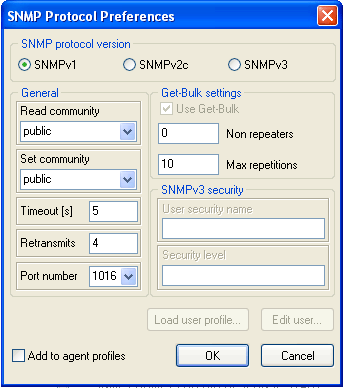
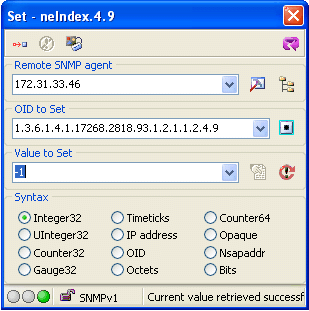
snmpset via mib browser
− or via command line (if using Linux, the net-snmp rpms should be installed)
snmpset -v 1 -c public $1:10161 1.3.6.1.4.1.17268.2818.93.1.2.1.1.2.4.0 i -1
Where:
[COMMON OPTIONS]:
-c public : set the community string
-v1 : specifies SNMP version to use
Agent/[OID]:
$1:10161 : specifies the IP address and listening port of the FOXMAN-UN proxy agent (e.g. 172.31.33.46:10161)
1.3.6.1.4.1.17268.2818.93.1.2.1.1.2.4.0: Hitachi Energy FOXMAN-UN neTable OID
[TYPE/VALUE]:
i -1: specifies the value for ‘NeId’. if the field is set to ‘-1’ it would trigger all the ne traps. If this is set to a specific ‘NeId’, it would trigger only the ne traps for this particular network element.
The snapshot below shows the alarm traps received by HLM, when the value is set to specific NeId (NeIndex), e.g. 11.
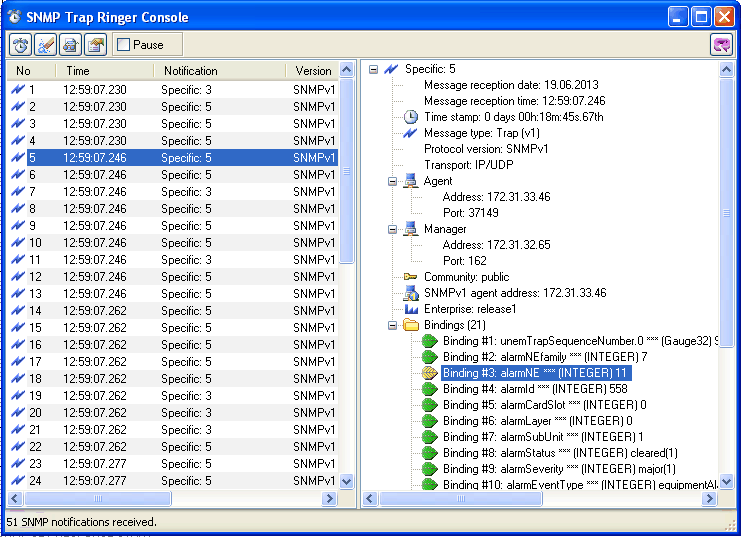
Traps received, value set to ‘NeId’ 11
When using the snmpset command with NeIndex -1 to generate traps from neTable,alarmTable, alarm traps for all NEs should be returned.
Example:
[nemsec@nemsrv ~]$ snmpset -v 2c -c public 172.31.41.82:10161 SNMPv2-SMI::enterprises.17268.2818.93.1.4.1.1.10.1.33.2 i -1
SNMPv2-SMI::enterprises.17268.2818.93.1.4.1.1.10.1.33.2 = INTEGER: -1